VectorReverb
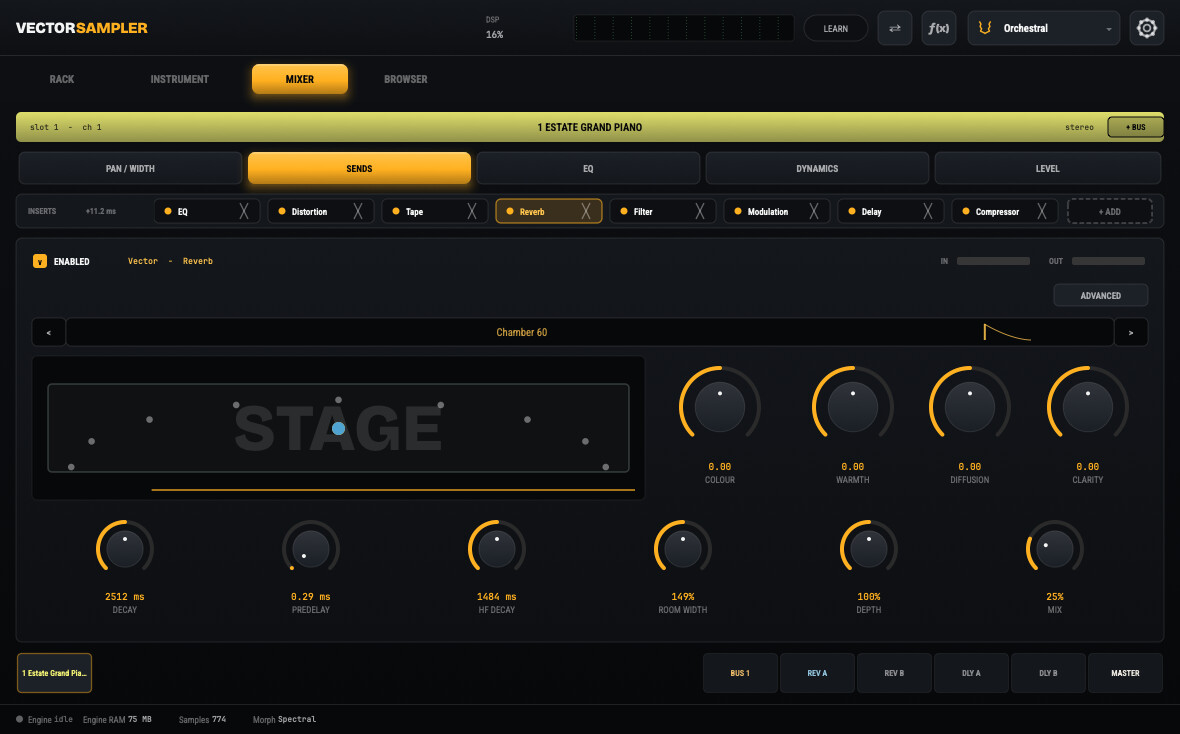
A single living algorithmic reverb whose every coefficient is derived from measurements of real acoustic spaces — morphing smoothly between room characters, and even reaching spaces no real room could physically be. The realism of measured rooms with the flexibility of an algorithm, instead of choosing one or the other.
The Problem
Reverb has always forced a trade. Convolution reproduces a real space convincingly but freezes it: one static impulse response replayed identically forever, carrying the room's character but also its capture noise, modal ringing, and the perceptual stiffness of a decay that never changes — and every instance costs a full set of transforms and a separate memory footprint.
Algorithmic reverb is alive and cheap, but it is conventionally voiced from invented numbers that correspond to no real space, and critical listeners often judge it the lesser sound. You are left choosing between realism without flexibility, or flexibility without realism — and if you want a real hall's envelopment on four sends at once, you pay for it four times over.
Key Features
- Measured, not inventedEvery engine coefficient is interpolated from measurements taken from real impulse responses — the realism of measured spaces, without the frozen stiffness of a static recording
- A surveyed character spaceDrawn from a large library of professional captures organized into four families — halls, plates, rooms, and chambers — each capture serving as both a morph anchor and a recallable preset
- One macro knobA "grand master" control travels a curated path through the space, coordinating orthogonal sub-controls beneath it; coefficient interpolation only, so traversal is click-free
- Affordable true multichannelOne shared, diffused late tail is a property of the room, while all position dependence lives in a lightweight directional early-reflection stage
- Measured spatializationBuilt from multichannel captures of real performance spaces, driving measured decorrelation and position-dependent reverberation instead of synthesized width
- Immersive-readyA native 7-channel internal field with fold-downs to stereo, 5.0, 7.0, and parametric binaural — one decode path, so the stereo monitor and the immersive outputs never diverge
- Independent voicingDecay Rate, Predelay, Brightness, and Stereo Width ride on top of the morph and pin to absolute values when grabbed, plus a Character control for living, modulated tails
- Far lighter than convolutionOne shared engine and multiple sends replace multiple partitioned-convolution instances, collapsing many impulse-response footprints into a single coefficient set
Read the Overview
How real impulse responses become coordinates in a continuous character space — and how one living engine can travel beyond the spaces that physically exist.
Read the VectorReverb OverviewPart of the OTTO / IDA Signal Path
The VectorReverb is one of the space and dynamics modules built for the OTTO and IDA engines. The same engine is also packaged as a standalone VST3, AU, CLAP, and AUv3 plugin in LOUIS, so it can be used on any track in any DAW.
The Engine
VectorReverb today runs as an insert inside the instruments it was built for. LOUIS is the same engine wrapped as a standalone plugin.